3 books on Military Sea Drones [PDF]
Like
13
Books on military sea drones serve as essential references for startups dedicated to the development and advancement of sea-based unmanned systems for military applications. These texts encompass a broad range of critical subjects, including marine robotics, autonomous navigation, sonar technology and communication systems specific to underwater environments. By delving into these resources, startups can gain a profound understanding of the complex engineering principles and operational considerations essential for effective military sea drone development. Historical perspectives and case studies within these books offer valuable insights into the evolution of underwater drone technologies, showcasing successful implementations, challenges faced and the strategic implications of various approaches.
1. Kamikaze Sea Drone: Discover the evolution and impact of kamikaze sea drones in modern naval warfare
2025 by StoryBuddiesPlay
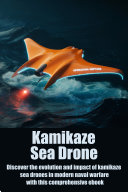
This AI-book takes a quick look at modern kamikaze naval drones, which have found wide application in the Russian-Ukrainian War in the Black Sea. Their hulls are made of lightweight materials such as reinforced plastics or composites to reduce the weight, provide high acceleration, maneuverability and reduce its radar signature. 3D printing is used to speed up production and reduce costs. Most kamikaze naval drones use electric motors powered by large-capacity batteries, allowing for silent propulsion and reduced risk of acoustic detection. But some may use compact internal combustion engines to increase range or speed. These drones are equipped with GPS receivers, internal navigation systems and visual or infrared cameras for real-time course correction. Operators can control the drone remotely via secure connection or the drone can operate autonomously. Typically, the payload is placed in the nose of the drone to detonate on impact. Its size and type of explosive selected depending on the target. Some drones are equipped with shaped charges to penetrate armored hulls, while others carry high-explosive munitions for maximum lethality against soft or unarmored targets. Integrating all of these systems requires special electronics and software. The control unit must coordinate the propulsion system, navigation, sensors, communications and detonation with high reliability, even in the face of countermeasures or radio interference.
Download PDF
2. Advances in Unmanned Marine Vehicles
2006 by G.N. Roberts, R. Sutton

This book provides an interesting look at the history of unmanned surface vehicles (USV). An important part of any USV is the onboard automatic steering system to maintain a course or route. Since the beginning of the Industrial Revolution, engineers have been developing a steering gear to automatically steer ships. The motivation for this came primarily from the needs of the navy: warships had to maneuver at high speeds. In the late 1860s, the British Admiralty equipped several of its sailing ships with various types of steering gear, many of which were based on a steam-hydraulic system. Engineers then turned their attention to devices that provided the steering gear with input signals from course-keeping equipment. The development of the electrically driven gyrocompass played a key role in the evolution of ship autopilots. The major contributions to the development of practical automatic ship steering systems were made by the Sperry Gyroscope Company. In 1911 it built the first automatic steering system, called Metal Mike because it imitated the actions of an experienced helmsman. Since those pioneering days, the design and development of unmanned marine vehicles has attracted increasing attention worldwide, as they are seen as cost-effective solutions for military applications. Interest in these vehicles is fueled by ongoing advances in control systems engineering, artificial intelligence and sensor technology, the availability of low-cost, high-performance computer systems and the development of communications networks such as GPS.
Download PDF
3. Autonomous Vehicles in Support of Naval Operations
2005 by National Research Council, Division on Engineering and Physical Sciences, Naval Studies Board, Committee on Autonomous Vehicles in Support of Naval Operations
The author of this book claims that although autonomous vehicles have been used in military operations for over 60 years (cruise missiles, satellites and unmanned aerial vehicles), they have not been used on the maritime front. However, the early experiments with maritime UAVs promise them an increasingly significant role in future naval operations. The progress is being driven by advances in computing and robotics, navigation, communications and networking, power units and materials. The U.S. Committee on Autonomous Vehicles in Support of Naval Operations recently developed a set of recommendations. Among the most significant points is the recognition that many naval requirements and goals can be met by existing AVs that are already in the inventory or under development by other agencies. Therefore, the U.S. Navy and Marine Corps should collaborate with other agencies to maximize the use of these systems in various stages of development. However, it is clear that there are unique requirements that require the Navy to develop technologies not owned by other agencies. Thus, it is important for the Navy to develop critical technologies related to autonomous vehicles that are considered essential to future naval missions. The committee also identified significant lacks in command, communications, computing, intelligence, surveillance and reconnaissance systems (C4ISR) that limit the effectiveness of AVs. It is therefore critical that the Department of the Navy develop and implement a comprehensive plan to address these C4ISR deficiencies.
Download PDF
How to download PDF:
1. Install Gooreader
2. Enter Book ID to the search box and press Enter
3. Click "Download Book" icon and select PDF*
* - note that for yellow books only preview pages are downloaded
1. Kamikaze Sea Drone: Discover the evolution and impact of kamikaze sea drones in modern naval warfare
2025 by StoryBuddiesPlay
This AI-book takes a quick look at modern kamikaze naval drones, which have found wide application in the Russian-Ukrainian War in the Black Sea. Their hulls are made of lightweight materials such as reinforced plastics or composites to reduce the weight, provide high acceleration, maneuverability and reduce its radar signature. 3D printing is used to speed up production and reduce costs. Most kamikaze naval drones use electric motors powered by large-capacity batteries, allowing for silent propulsion and reduced risk of acoustic detection. But some may use compact internal combustion engines to increase range or speed. These drones are equipped with GPS receivers, internal navigation systems and visual or infrared cameras for real-time course correction. Operators can control the drone remotely via secure connection or the drone can operate autonomously. Typically, the payload is placed in the nose of the drone to detonate on impact. Its size and type of explosive selected depending on the target. Some drones are equipped with shaped charges to penetrate armored hulls, while others carry high-explosive munitions for maximum lethality against soft or unarmored targets. Integrating all of these systems requires special electronics and software. The control unit must coordinate the propulsion system, navigation, sensors, communications and detonation with high reliability, even in the face of countermeasures or radio interference.
Download PDF
2. Advances in Unmanned Marine Vehicles
2006 by G.N. Roberts, R. Sutton
This book provides an interesting look at the history of unmanned surface vehicles (USV). An important part of any USV is the onboard automatic steering system to maintain a course or route. Since the beginning of the Industrial Revolution, engineers have been developing a steering gear to automatically steer ships. The motivation for this came primarily from the needs of the navy: warships had to maneuver at high speeds. In the late 1860s, the British Admiralty equipped several of its sailing ships with various types of steering gear, many of which were based on a steam-hydraulic system. Engineers then turned their attention to devices that provided the steering gear with input signals from course-keeping equipment. The development of the electrically driven gyrocompass played a key role in the evolution of ship autopilots. The major contributions to the development of practical automatic ship steering systems were made by the Sperry Gyroscope Company. In 1911 it built the first automatic steering system, called Metal Mike because it imitated the actions of an experienced helmsman. Since those pioneering days, the design and development of unmanned marine vehicles has attracted increasing attention worldwide, as they are seen as cost-effective solutions for military applications. Interest in these vehicles is fueled by ongoing advances in control systems engineering, artificial intelligence and sensor technology, the availability of low-cost, high-performance computer systems and the development of communications networks such as GPS.
Download PDF
3. Autonomous Vehicles in Support of Naval Operations
2005 by National Research Council, Division on Engineering and Physical Sciences, Naval Studies Board, Committee on Autonomous Vehicles in Support of Naval Operations
The author of this book claims that although autonomous vehicles have been used in military operations for over 60 years (cruise missiles, satellites and unmanned aerial vehicles), they have not been used on the maritime front. However, the early experiments with maritime UAVs promise them an increasingly significant role in future naval operations. The progress is being driven by advances in computing and robotics, navigation, communications and networking, power units and materials. The U.S. Committee on Autonomous Vehicles in Support of Naval Operations recently developed a set of recommendations. Among the most significant points is the recognition that many naval requirements and goals can be met by existing AVs that are already in the inventory or under development by other agencies. Therefore, the U.S. Navy and Marine Corps should collaborate with other agencies to maximize the use of these systems in various stages of development. However, it is clear that there are unique requirements that require the Navy to develop technologies not owned by other agencies. Thus, it is important for the Navy to develop critical technologies related to autonomous vehicles that are considered essential to future naval missions. The committee also identified significant lacks in command, communications, computing, intelligence, surveillance and reconnaissance systems (C4ISR) that limit the effectiveness of AVs. It is therefore critical that the Department of the Navy develop and implement a comprehensive plan to address these C4ISR deficiencies.
Download PDF
How to download PDF:
1. Install Gooreader
2. Enter Book ID to the search box and press Enter
3. Click "Download Book" icon and select PDF*
* - note that for yellow books only preview pages are downloaded